
Precision machining , Beta titanium pipe
futaku
FUTA-Q,Ltd.
HOME » FUTA-Q Technology » Welding » TIG welding
TIG welding
TIG welding
update :
High precision in machining and quality in joining have to be simultaneously achieved in making components such as connectors, piping parts, or nozzles used for equipment and machinery in semiconductor or pharmaceutical manufacturing, which are to be operated in highly controlled environments.
TIG welding is suitable to fulfill this requirement, and is being used in a wide range of applications for its capability of forming a penetration with minimal compositional changes caused by oxidation.
What is TIG welding?
In TIG welding, a tungsten electrode is involved while the region under welded being covered with argon gas, so that the electrode and the joining area will be oxidized to the minimum, resulting in a high-quality welding. The build-up welding with a filler rod minimizes the reductions in the joining strength and the significant change in the dimensions. (TIG stands for Tungsten Inert Gas.)
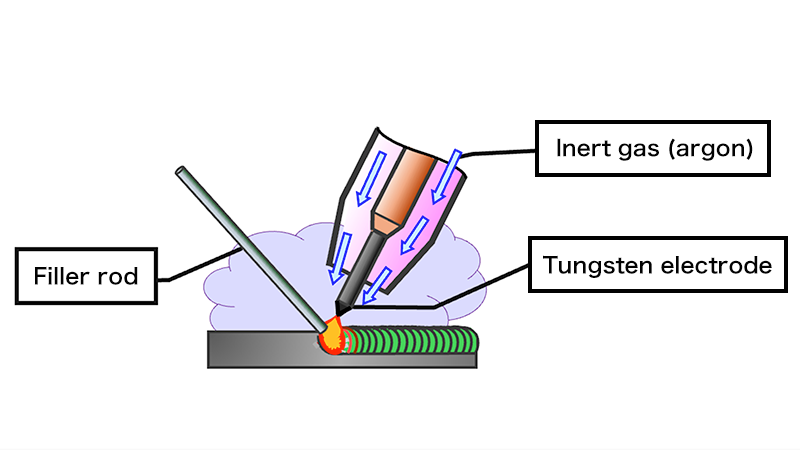
Applicable materials
TIG welding can be applied to a wide range of high-performance metallic materials as follows; stainless steel (SUS304, SUS316L, SUS430, etc.), titanium and titanium alloys, aluminum alloys, and nickel alloys (Hastelloy, Inconel, etc.)
Weld cross-section
Whether welding deeply to enhance the joint’s reliability or shallowly to reduce machining distortion in the welded area, can be determined by changing the welding parameters.
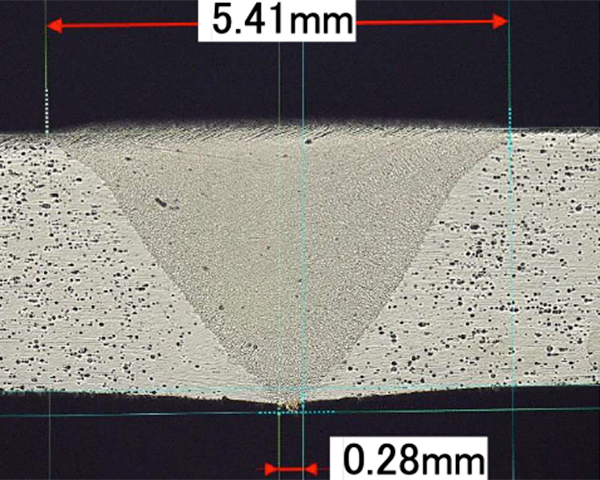
Deep penetration welding
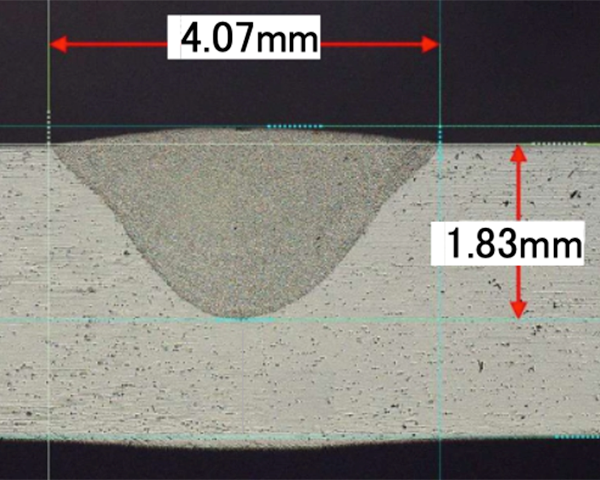
Shallow penetration welding
TIG welding examples
TIG welding is often used to weld precision components in semiconductor manufacturing equipment, pharmaceutical manufacturing equipment, or analytical instruments.
By strictly controlling the welding environment and conditions, high-quality welds can be achieved even on small-diameter pipes or on highly precise components.
Pipe welding
The automatic TIG pipe-welding machine provides consistent quality in making welded pipes.
Material: SUS316
Dimension: Φ50 OD, 3 mm thick
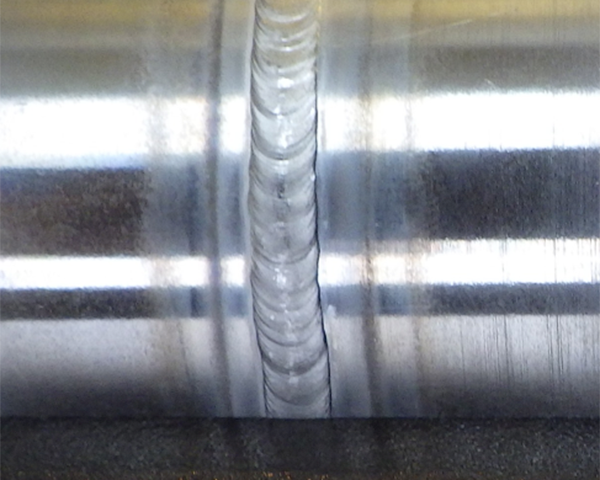
Applying the “backing bead welding” technique, in which the material is deeply melted into the back side, can minimize possible troubles of a piping system such as liquid pooling in the gaps inside the pipe or reduced mechanical strength at the jointed area.
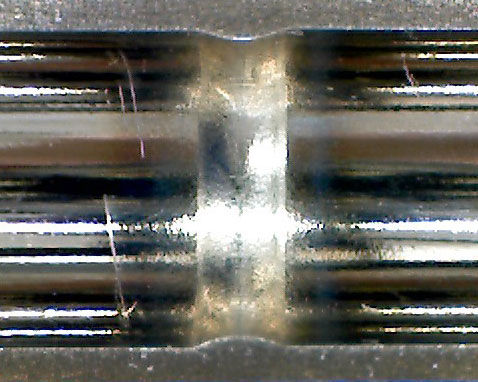
Internal sectional view of a welded pipe
Build-up welding of a block material and pipes
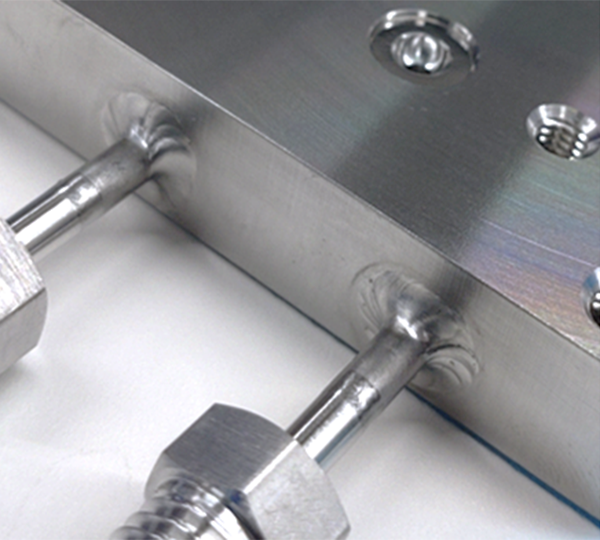
Material: SUS316
Build-up welding of a base block and narrow pipes (1/8-inch OD with wall thickness of 0.7 mm)
Butt welding of pipes for a piping system
Our pipe welding shop can also conduct butt-welding to joint a union tee and union fittings. Forming back beads on the inner surface of the pipe, through which a gas or liquid will flow, makes seamless and burn-free welded-pipes.
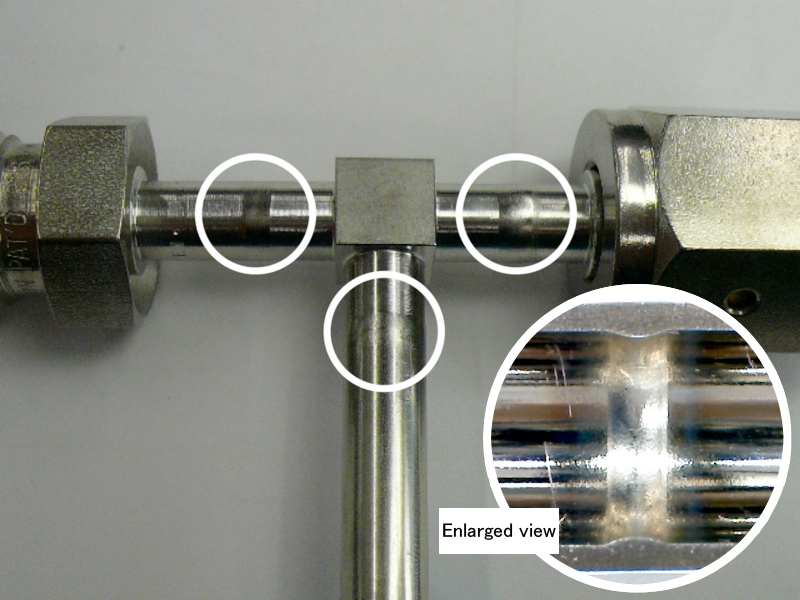
Inspection of TIG welding
TIG welding is often considered as a special technique requiring craftmanship, that is, the worker’s skill and expertise.
At FUTA-Q, the improvements and consistency in the welding quality are achieved by using the combined technologies for scientifically verifying welding conditions and welding results.
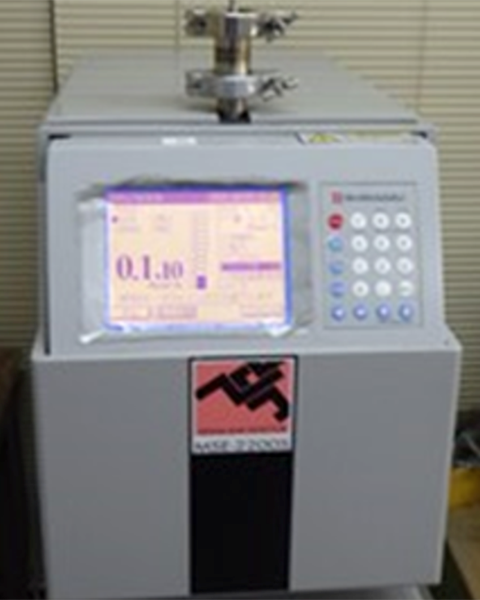
Helium leak detector
This detector is used to check any leakage at metal joints.
< Helium leak detector – Inspection specifications >
≤ 1×10⁻¹⁰ Pa·m³/s (Helium)
This can detect minute leaks, and whereby ensures the components, which will be used in high-vacuum environments, to be reliable for leak-free.
Color check (Dye penetrant inspection)
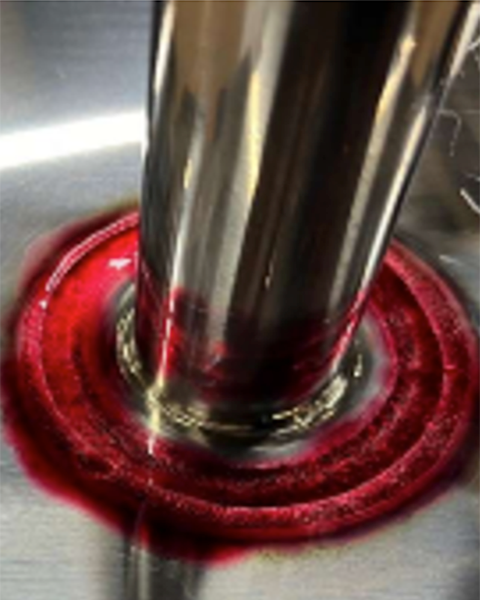
Applying red dye-penetrant to a joint area visualizes defects at the area which are often invisible to the naked eye.
Frequently asked questions on TIG welding and a manufacturing order to FUTA-Q
- What kind of welding method is TIG welding?
- TIG welding is a method in which an inert gas is used to protect the welded area from contaminations during welding, featuring the ability to form a high-quality welding with minimal contaminations. It is suitable for making precision components highly airtight, which are used in precision machineries such as semiconductor manufacturing equipment, pharmaceutical manufacturing equipment, and analytical instruments.
- An order for making just one prototype is acceptable?
- Yes, we are pleased to accept the order for a single prototype. Along with that, we can provide the comprehensible supports covering from prototyping in the development phase to designing of the mass production processes coming subsequently.
Please feel free to consult us on manufacturing of high-precision parts with complex geometries as well as of components requiring special materials. - What are the benefits of placing order with FUTA-Q in TIG welding?
- Our strength in the welding process lies in the combination of our skilled craftsmanship and the quality control based on scientific analysis. We regularly analyze our welding results and process parameters using scientific methods, which enables us to provide highly reliable products supported by numerical evidence through our in-house evaluation and inspection system.
- Is it possible to secure airtightness of components with welding?
- Yes, we can conduct hermetic welding with which the part is usable in vacuum environment.
After welding, the leak test is conducted using the helium leak detector. Hence our quality control can meet the standards for manufacturing pharmaceutical or semiconductor equipment.
Relevant webpages to TIG welding in FUTA-Q
Leak detection testing devices
Leak detection testing devices
To ensure that we provide high-quality components that are free from liquid or gas leaks, FUTA-Q conducts a variety of leak tests.
Laser welding
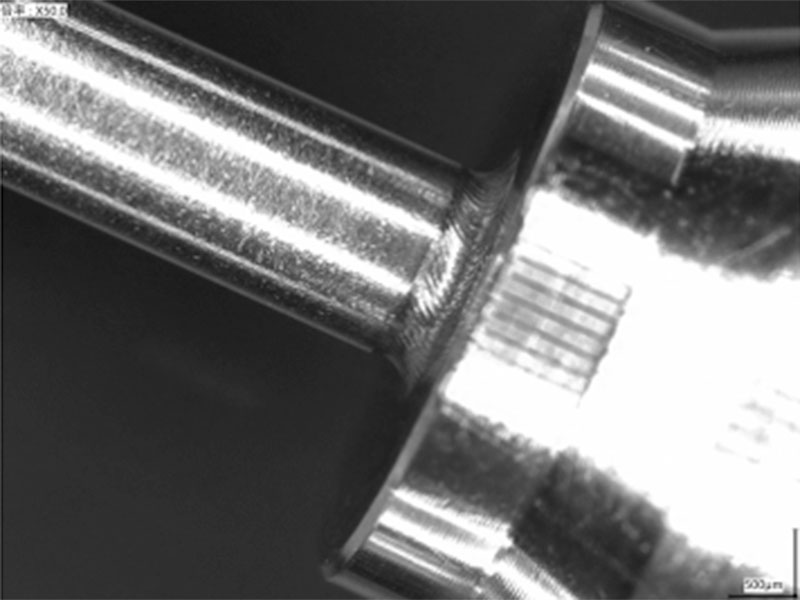
Laser welding enables deep penetration welding (where the penetration depth is significant relative to the width). FUTA-Q utilizes a variety of laser welding machines having different kinds of laser sources and output specifications to meet each client’s specific need.

For semiconductor manufacturing equipment
– For semiconductor manufacturing –
We provide various components for cutting-edge semiconductor manufacturing equipment requiring airtightness and cleanliness for achieving ultra-high vacuum.